Scaling METALGO's Organic Traffic via Google Discover
Overview
In the highly competitive digital financial ecosystem, capturing user attention requires moving beyond traditional search engines. For METALGO (under PT Bullion Ecosystem International), the objective was to penetrate Google Discover, the pinnacle of 'query-less' search. Instead of a sitewide overhaul, I spearheaded a targeted content initiative designed specifically to test and trigger the Discover algorithm. By seamlessly integrating Behavioral Research with on-page User Experience (UX), I successfully engineered a strategic piece of content that aligned perfectly with user psychology, driving high-intent, proactive traffic directly to the platform.
The Challenge
Succeeding in Google Discover presents unique hurdles, especially within the financial and commodity sector:
The 'Query-less' Void: I could not rely on keyword search volume. The content had to earn its place in the user's feed based purely on historical interest and algorithmic prediction.
The Scroll Factor: Competing against mainstream news and entertainment in a user's feed meant my textual UX had to be immediately arresting but highly credible.
Topic Complexity: Financial decision-making inherently carries a high cognitive load. Presenting complex financial dilemmas without overwhelming the user was critical to preventing high bounce rates.
Ideation & Approach
To solve these challenges, I moved beyond technical SEO checklists and implemented a proprietary Behavioral Research Framework. Rather than chasing algorithm updates, the ideation process focused on deconstructing human psychology.
For this specific content initiative, I mapped out key psychological triggers that would act as 'signals' to the Discover recommendation engine:
Self-Relevance & Curiosity Gap: Designing the initial hook to make users feel the content was explicitly addressing their current life stage and financial dilemmas.
Attractiveness Bias: Utilizing visual design principles for the cover image to stand out in a cluttered feed.
Decision Paralysis: Recognizing that users often freeze when faced with financial choices, the content was conceptualized to simplify these options into clear, actionable paths.
Our Strategy
The execution focused heavily on the intersection of Content Structure and User Behavior. I optimized the targeted article through three core UX/Behavioral pillars:
The "First-Touch" UX: I engineered the meta-data and thumbnail not for search engines, but for human scrolling behavior. By combining Curiosity Gap (asking a compelling, relatable question) with Attractiveness Bias (clean, high-contrast visual assets), I maximized the initial click-through rate without crossing into clickbait territory.
Structuring for Cognitive Ease: Financial content often fails due to poor readability. Once the user clicked, the on-post (article content) UX was meticulously structured to reduce mental effort. I utilized scannable reading patterns, strategic whitespace, and distinct typographic hierarchies. By breaking down complex financial concepts into digestible comparisons, I significantly improved 'Cognitive Ease', keeping users engaged and signaling high content value to Google.
Establishing Trust via Risk Mitigation: In the financial niche, trust is a ranking factor. The UX was optimized to immediately present E-E-A-T (Experience, Expertise, Authoritativeness, Trustworthiness) signals. Clear story telling, upfront summaries, and a professional, objective tone acted as Risk Mitigation elements, reassuring the reader and reducing immediate bounce rates.
The Results

By shifting the focus from keyword density to human behavior and UX optimization, this targeted content piece successfully triggered algorithmic affinity within Google Discover.
During the monitored sprint, this specific initiative yielded:
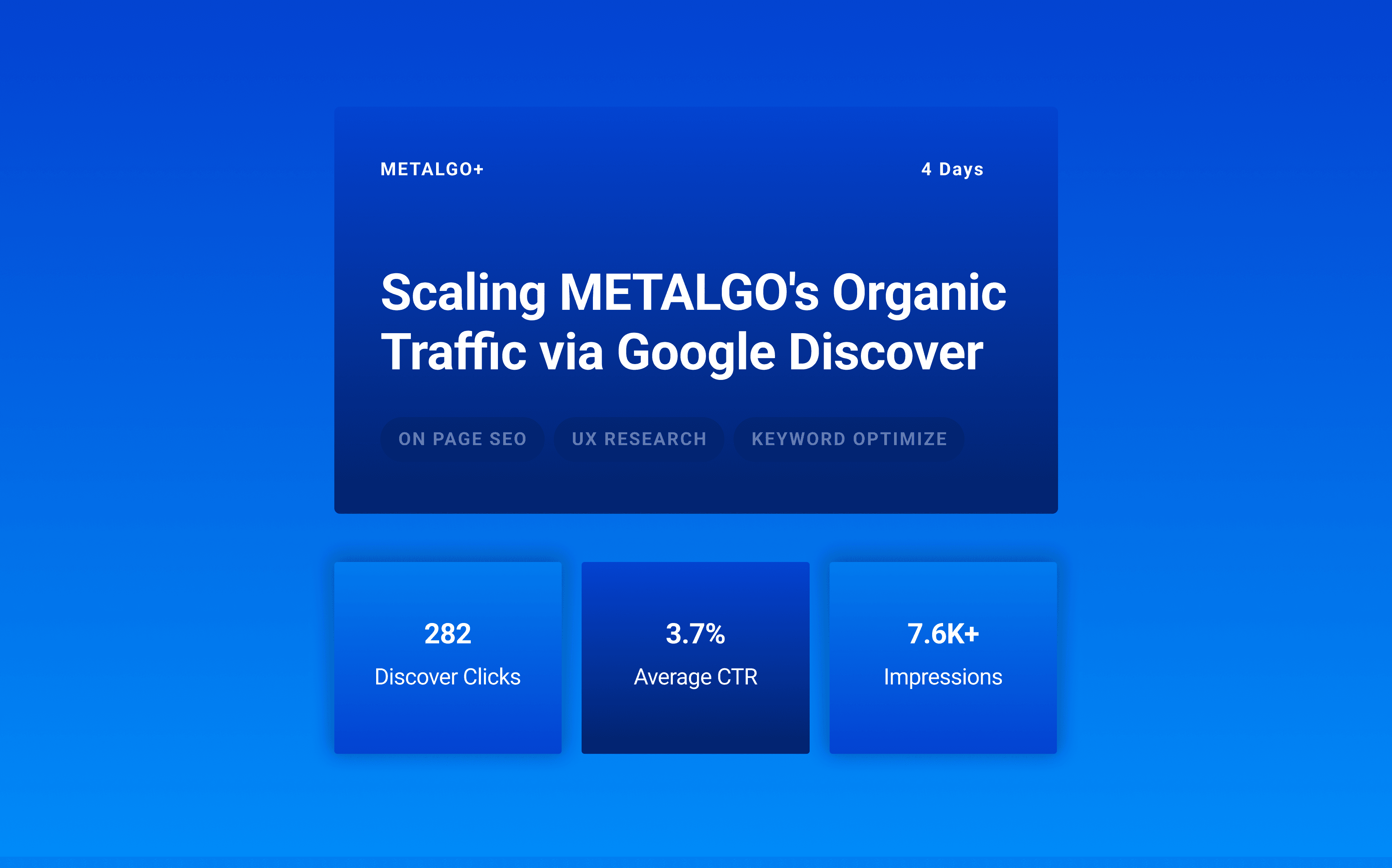
7.6K+ Discover Impressions: Directly from the Google Discover feed, proving successful algorithmic penetration.
282 Clicks: Generated proactively, independent of traditional search queries.
3.7% Average CTR: Validating that the First-Touch UX and psychological hooks successfully resonated with the target audience’s latent interests.
Reflection
This project serves as a definitive case study that modern SEO is intrinsically linked to User Experience. It highlights that Behavioral SEO is not a "one-size-fits-all" template. The application of Risk Mitigation and Cognitive Ease was tailored specifically to the financial sector's audience profile. Ultimately, by optimizing for human psychology first, understanding how users process information and make decisions, the search algorithm naturally follows, resulting in scalable, high-quality organic traction.